
Somewhere along the way, multiple sclerosis became one of the most misunderstood diseases out there.
People hear the words MS and picture one thing. A wheelchair. A tragedy. An ending. While none of those images are entirely wrong for everyone, they are not the full picture for almost anyone.
Common MS misconceptions do real damage. They shape how employers treat employees, how friends respond to a diagnosis, and how newly diagnosed people see their own future before they have had a chance to live it.
It is time to stop believing the myths and start understanding the disease for what it actually is.
Quick Answer: Common MS misconceptions include the belief that MS always leads to a wheelchair, affects everyone the same way, is contagious, is caused only by stress, or makes a full life impossible. In reality, MS varies widely from person to person, and many people continue to live meaningful, active lives after diagnosis.
Common MS Misconception 1: MS Always Means a Wheelchair
This is probably the most persistent myth out there, and it is simply not accurate.
What is multiple sclerosis, really? It is a chronic disease of the central nervous system in which the immune system attacks the protective covering of nerve fibers. The symptoms and severity vary enormously from person to person.
Many people living with MS walk, run, work full time, raise families, and build careers, sometimes for decades after diagnosis. Mobility aids help some people some of the time. They are not an inevitable outcome for everyone.
Patti Bevilacqua was diagnosed with MS five months into her first year of teaching high school physical education. Decades later, she has earned a PhD, stood on a TEDx stage, and built a career as a speaker and author. Her story alone disproves the idea that an MS diagnosis writes a single, predictable ending.
Common MS Misconception 2: MS Is the Same for Everyone
This misconception causes real harm because it leads people to dismiss or misunderstand individual experiences.
There are several types of multiple sclerosis, and they behave very differently. Understanding the difference between relapsing and progressive forms of MS is one of the most important distinctions.
Relapsing-remitting MS (RRMS) is the most common form. It involves clear flare-ups of new or worsening symptoms followed by periods of partial or full recovery.
Secondary progressive MS (SPMS) often develops after RRMS. Symptoms begin to worsen more steadily over time, with fewer distinct relapses.
Primary progressive MS (PPMS) involves a gradual, ongoing worsening of symptoms from the beginning, without the pattern of relapses and remissions.
Clinically isolated syndrome (CIS) refers to a first episode of neurological symptoms that may or may not develop into MS, depending on further testing and disease activity.
Two people with the same diagnosis can have completely different daily realities. One might experience years of stability. Another might face frequent flares. Neither experience is more valid than the other, and neither defines what MS “really” looks like because there is no single version of this disease.
Common MS Misconception 3: MS Is Contagious
This one might sound obvious, but it remains a real and damaging misconception.
MS is an autoimmune condition, not an infectious disease. It cannot be spread through contact, shared spaces, or proximity.
Yet the fear and stigma surrounding chronic illness sometimes lead people to unconsciously distance themselves from someone who has been diagnosed, as though the disease itself could somehow be transferred.
Multiple sclerosis awareness campaigns have worked for years to correct this misunderstanding, but the myth persists in quiet, unspoken ways, often shaping how people behave even when they would never say it out loud.
Common MS Misconception 4: Stress Alone Causes MS Relapses
Stress is often blamed entirely for MS flares. While it can play a role, the reality is more nuanced.
Stress may worsen symptoms for some people, but MS relapses are complex and should not be reduced to a single emotional cause. A true relapse is typically defined as new or worsening neurological symptoms lasting at least 24 hours without the presence of an infection or fever.
MS relapse triggers can include infection, extreme heat, lack of sleep, hormonal changes, and stress. No single factor is solely responsible for a relapse.
Understanding the full range of triggers helps people manage their condition with greater accuracy and far less self-blame.
Common MS Misconception 5: A Diagnosis Means Your Life Is Over
This might be the most damaging misconception of all.
When people hear the words, “You have MS,” it is easy to believe the life they imagined has disappeared. That fear is understandable. A diagnosis changes things. It brings uncertainty, grief, and questions no one expected to ask.
But it is not the end of your story.
People living with MS build careers, raise families, discover new passions, and find purpose they never imagined possible. The path may look different from the one they planned, but different does not mean less meaningful.
Patti Bevilacqua understands that journey firsthand. After being diagnosed with MS five months into her first year of teaching high school physical education, she spent nearly ten years searching for what came next after leaving the profession she loved. That search eventually led to a PhD, a TEDx talk, and a career helping others see possibility where they once saw only loss.
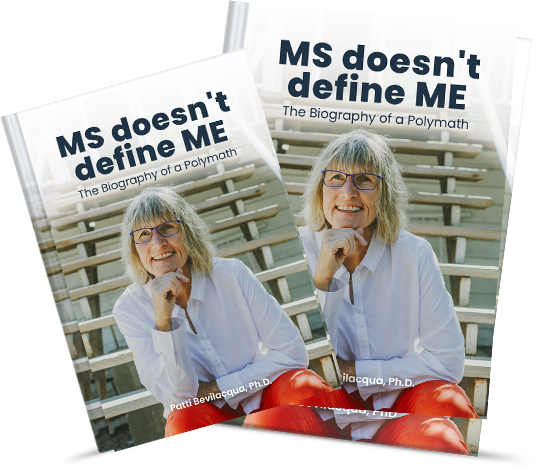
In MS doesn’t define ME, she shares that journey honestly, including the uncertainty, setbacks, and unexpected opportunities that followed. You can also read more about one of those turning points in the post about the day she learned her MS treatment was a placebo.
Why These Misconceptions Matter
Common MS misconceptions are not harmless misunderstandings. They shape real decisions.
Whether someone discloses their diagnosis at work, how friends and family respond in the early days after a diagnosis, the internal narrative a newly diagnosed person builds about their own future, all of this is influenced by what people believe about MS, often before the person diagnosed has had the chance to discover what is actually possible.
Replacing myth with accurate understanding is not just an educational exercise. It is an act of advocacy.
If you want a clearer picture of what multiple sclerosis actually involves, including symptoms, types, and what life after diagnosis can look like, this plain-language guide to multiple sclerosis is a good place to start.
The Truth Behind the Myths
Multiple sclerosis is complex, individual, and far more varied than the common narrative suggests.
What MS does mean is adaptation. Learning a new relationship with your body. Building a life that may look different from the one you planned while still being full, purposeful, and entirely your own.
Patti Bevilacqua’s journey is one example of that. Her story, along with the stories of countless others living with MS, reminds us that there is no single path after diagnosis and no single definition of what living well with MS looks like.
If you want to read a real, honest account of what life with MS can become, MS doesn’t define ME is available through the Patti Bevilacqua Shop.
Frequently Asked Questions
Q1: Does an MS diagnosis always mean using a wheelchair eventually?
No. MS symptoms and severity vary significantly from person to person. Many people living with MS maintain their mobility for years or even decades, while others may use mobility aids at certain points. There is no single, predictable outcome for everyone diagnosed.
Q2: Is multiple sclerosis contagious?
No. MS is an autoimmune condition, not an infectious disease. It cannot be transmitted through contact, shared spaces, or proximity to someone who has it.
Q3: What actually triggers an MS relapse?
MS relapse triggers vary by individual and can include infection, extreme heat, lack of sleep, hormonal changes, and stress. No single factor is solely responsible for a relapse.
Q4: Are all types of MS the same?
No. There are different types of multiple sclerosis, including relapsing-remitting and progressive forms, each with distinct patterns of symptoms and progression. Two people with MS can have very different daily experiences.
Q5: Can someone live a full life after an MS diagnosis?
Yes. Many people living with MS build meaningful careers, relationships, and personal goals after diagnosis. A diagnosis marks a change in direction, not the end of a purposeful life.