
What a bag of saline taught me about belief, resilience, and possibility
When I was diagnosed with MS, something happened that no one really prepares you for. It wasn’t just the physical symptoms that changed my life. It was the quiet shift in how people talked about my future. Conversations suddenly included words like “limits” and “adjustments.” Doctors spoke about progression. People around me began speaking more carefully, as though my life had suddenly become fragile.
Those messages are subtle, but they sink in.
Not all at once. Slowly. Like bricks being placed into an invisible backpack.
You start to wonder what you won’t be able to do anymore. You start measuring your future by what might be lost instead of what might still be possible.
A Research Study Offered New Hope
Around that time, the MS Clinic at the University of British Columbia called to say I qualified for a research study. The trial involved an infusion every six months that researchers hoped might slow the progression of MS. I barely remember anything the nurse said after the words “you qualify.” All I could think was maybe this was the break I had been waiting for.
On the morning of my first infusion, the clinic smelled faintly of antiseptic and old coffee. A nurse with kind eyes inserted the IV while fluorescent lights buzzed overhead. I watched the clear liquid drip through the tubing as if it carried magic. I remember thinking that something inside that bag might turn my life around.
And then something unexpected happened.
Within hours I felt energy I hadn’t experienced in a long time. My body felt lighter. My mind felt clearer. I went home and started cleaning the house with the kind of determination normally reserved for spring cleaning. I vacuumed the rugs, wiped the countertops, and reorganized a drawer I had avoided for months. My legs felt stronger. My right arm cooperated in ways that surprised even me.
That night I lay in bed staring at the ceiling, grateful and amazed, whispering thank you to the miracle I believed was flowing through my veins.
For months, I rode that wave of hope. Grocery shopping became easier, no longer needing to lean on the cart. Laundry could be folded without resting every few minutes. Moving through the world, I felt as though something inside me had shifted.
Six months later I returned for the second infusion with the same quiet optimism.
The Letter That Changed Everything
Then, eighteen months after the study began, a letter arrived in the mail.
For a long moment I stood in the hallway holding that letter from the MS clinic, staring at the sentence that changed everything: You were randomized to the placebo group. Placebo. Sugar water. Nothing. Yet somehow I had still vacuumed the house at midnight, hauled groceries, walked around the block, and felt stronger than I had in years. Which meant the strength hadn’t come from a miracle drug dripping into my veins. It had come from somewhere inside me. In that quiet moment between disbelief and laughter, a realization cracked open. If belief alone could spark that much energy in a body living with MS, then maybe the most powerful medicine I would ever carry wasn’t in a hospital IV bag at all. Maybe it was the story I chose to believe about myself.
What the Placebo Revealed
That realization changed the way I understand resilience.
MS did not disappear. My symptoms did not magically vanish. But something inside my thinking shifted. I began to see that the mind and body are always in conversation, and the stories we tell ourselves about what is possible matter more than we often realize.
The placebo had not cured anything. What it revealed was something far more interesting. My mind was not just a passive observer of what MS was doing to my body. It could also influence how I responded to it.
Over time, that insight began shaping how I approached my life. I started experimenting with mindset in small ways. Visualization. Gratitude. Self talk that nudged me toward possibility instead of despair. Some days it helped. Other days MS reminded me it was still there. But even on the difficult days, I carried proof that something powerful lived inside me.
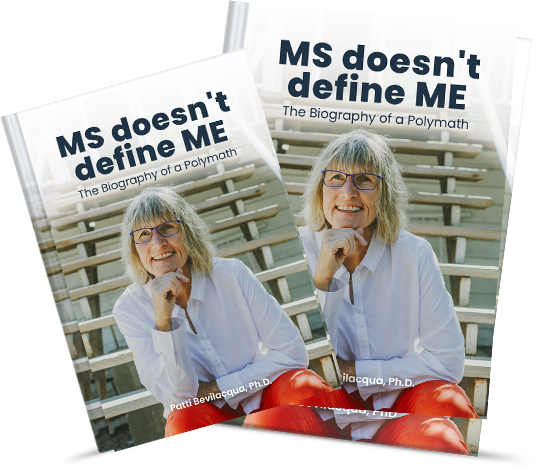
That lesson eventually became part of the journey I share in my book MS doesn’t define ME: The Biography of a Polymath. The book is not just about living with MS. It is about identity, resilience, reinvention, and what happens when life forces you to rethink the story you once believed about yourself.
Because here is what the placebo taught me.
Sometimes the most powerful shift does not come from a treatment.
Sometimes it comes from realizing that belief itself can open doors we thought were closed.
A diagnosis may change the road you are traveling.
But it does not get to define who you become.
This story is adapted from my book MS doesn’t define ME: The Biography of a Polymath.